My friend Jessie Bennett at Beacon Press produced this video.
Thursday, March 22, 2012


Wednesday, March 21, 2012
A book about the business of youth sports
It has been months since the last post. I've been writing (and writing). Just not here. I'm pleased to say that the official publication date for The Most Expensive Game in Town was yesterday. It's a book on an important subject - the commercialization of sports for kids. I hope it will spur discussion and debate, maybe even modest change.
There will be reviews and interviews over the next few weeks. I'll post a few here. If you'd like to be kept in the loop about more book stuff, I hope you'll "like" the book page on Facebook.
Doug Glanville, the former major-league-baseball-player-turned author and essayist, has written a thoughtful piece about what's lost when youth sports becomes as crass a business as every other crass business, and about the book. This article posted to the Time Magazine Ideas Web site today.
Thanks to all those who inquired where I've been and when I was going to get my lazy butt back to work on the blog.
There will be reviews and interviews over the next few weeks. I'll post a few here. If you'd like to be kept in the loop about more book stuff, I hope you'll "like" the book page on Facebook.
Doug Glanville, the former major-league-baseball-player-turned author and essayist, has written a thoughtful piece about what's lost when youth sports becomes as crass a business as every other crass business, and about the book. This article posted to the Time Magazine Ideas Web site today.
Thanks to all those who inquired where I've been and when I was going to get my lazy butt back to work on the blog.
Wednesday, August 17, 2011
Just in case there wasn't enough pressure....
The latest from Williamsport - Little League World Series video scouting reports. Ugh.
Tuesday, August 16, 2011
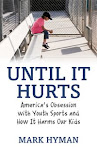
Until It Hurts, the Video
Beacon Press just put out this short clip about Until it Hurts. Thanks to Jessie Bennett, Digital Content Developer and Blog Editor at Beacon.
Monday, August 15, 2011
PGA Championship winner had a real childhood

Keegan Bradley, the new PGA Championship winner, set himself apart in so many ways last week. He won one of golf's four major championships in his first season on the PGA Tour. He won with an improbable back nine that included a triple bogey (to drop him five shots off the lead with three holes to play) followed by back-to-back birdies. Even more remarkably, he won the first major championship he ever played in.
There's one more biographical footnote that separates Bradley from other tour pros. He had a childhood.
More accurately, he had a normal childhood. Bradley grew up in Vermont, the son of a teaching golf pro. His aunt, Pat Bradley, was one of the most successful players on the Ladies Professional Golf Association tour in the 1970s and 1980s. The adults in Keegan's life had the good sense to allow golf to be a part of his life, not his whole life.
Increasingly, that's an unusual way for kids with sports talent to grow up, as Bill Pennington explained this morning in the New York Times.
Although he is the son of a club teaching pro and the nephew of the L.P.G.A. Hall of Famer Pat Bradley, he did not specialize in golf as a youngster. He did not enroll in a hundred golf camps or travel away from home, boarding in a golf academy. He did not follow the path that is now so common to precocious athletes in most sports across America, which is to say he spurned suggestions he should quit all other sports and play golf year-round.
Bradley grew up in central Vermont. He was a ski racer in the winter and a golfer in the summer.
“People ask me all the time how I could be a pro golfer from Vermont, and they assume I must have went south a lot,” Bradley said Saturday. “But the truth is that when it started to snow, I put my clubs in the basement and didn’t touch them.”
In Until It Hurts, I write about kids who become early specialists. By eight or nine years old, they are full-time soccer goalies or tennis players. A small percentage of these children become fabulous players. They become varsity college athletes, attending school on full athletic scholarship. A few even become professional stars playing in big stadiums and earning millions of dollars a year.
Sadly, most do not. They advance as far as their talent will take them, usually high school sports -and no farther. Or the steady diet of one sport - spring, summer, fall and winter - eventually wears them down before they even get that far. As I write in Until It Hurts, they become victims of overuse injuries, ruptured ligaments, growth-plate injuries and the like. Or the sport ceases to be fun. Or what they want to do. So they quit before ever reaching their potential.
Keegan Bradley's parents played it right. They allowed their son to have a childhood, to explore many interests and eventually to excel at one. Keegan is the hero this week. Mr. and Mrs. Bradley deserve their own slice of the spotlight.
Thursday, August 04, 2011
A new study confirms an old one on kids and curves
Back in 2009, I wrote an article for the New York Times citing a study that concluded there isn't much evidence to link curveballs and arm problems among kid pitchers. According to the study, the far more serious problem was overuse - too many pitches thrown over seasons dragging on too many months. It turned conventional thinking about kid pitchers and throbbing elbows on its head. Yet the study's primary author, Glenn Fleisig, was quite sure about which way his data pointed.
From the article:
Fleisig took a lot of heat for the study and for refusing to back away from its conclusions. This week, vindication of sorts. A five-year study conducted at the University of North Carolina and commissioned by Little League Baseball reached the same conclusion.
As Glenn said in the Times article, no one is urging ten-year-olds to snap off a curve every other pitch. But data are data, and the curveball apparently isn't as harmful as many of us thought. And I have both hands raised on this one. In 2005, I wrote a piece for the Times lamenting the all-curve all-the-time approach of many youth pitchers at the Little League World Series. I should have been writing about pitch counts.
From the article:
Why for so many decades have most doctors and youth coaches believed otherwise? Fleisig said the evidence had been based largely on anecdotes, and that over the years those stories simply began to sound like fact.
“Why did people believe the world was flat? Because one guy told another it was flat and it looked flat. Until someone discovered that it wasn’t,” he said.
Fleisig took a lot of heat for the study and for refusing to back away from its conclusions. This week, vindication of sorts. A five-year study conducted at the University of North Carolina and commissioned by Little League Baseball reached the same conclusion.
As Glenn said in the Times article, no one is urging ten-year-olds to snap off a curve every other pitch. But data are data, and the curveball apparently isn't as harmful as many of us thought. And I have both hands raised on this one. In 2005, I wrote a piece for the Times lamenting the all-curve all-the-time approach of many youth pitchers at the Little League World Series. I should have been writing about pitch counts.
Friday, July 29, 2011
Paying for a field hockey tutor, before taxes
This makes sense. Rep. Kevin Brady (R-Texas) just introduced a bill that would allow you and me to use pre-tax dollars to pay for heath and fitness expenses. So just as we can set aside a few thousands bucks (pre-tax) for medical expenses now, the same could be done to pay for the gym membership, the yoga class, maybe the youth soccer registration.
“Regular physical activity is the best preventive medicine we can prescribe,” Brady said this week. “This bill will give people another incentive to get active – to participate in that exercise class, join a sports team, or sign up for a fitness program.”
I like the idea. I see a few complications, though. Like what exactly is an allowable expense? I drop my kid off at the batting cage and she goes through ten dollars in quarters. My son enters the New York City Marathon. I sign up my kid for field hockey lessons at $50 a pop. I bought a Nintendo Wii. I bought six Nintendo Wiis. My wife had a baby on Monday. Tuesday, I order Baby Goes Pro on DVD. How far can I push this envelope?
What's truly remarkable about the bill - especially this week - is that it's supported by Republicans and Dems. Ron Paul and Earl Blumenauer, who I'm guessing rarely agree on what time it is, are co-sponsors. If nothing else, let's give this group credit for getting along.
“Regular physical activity is the best preventive medicine we can prescribe,” Brady said this week. “This bill will give people another incentive to get active – to participate in that exercise class, join a sports team, or sign up for a fitness program.”
I like the idea. I see a few complications, though. Like what exactly is an allowable expense? I drop my kid off at the batting cage and she goes through ten dollars in quarters. My son enters the New York City Marathon. I sign up my kid for field hockey lessons at $50 a pop. I bought a Nintendo Wii. I bought six Nintendo Wiis. My wife had a baby on Monday. Tuesday, I order Baby Goes Pro on DVD. How far can I push this envelope?
What's truly remarkable about the bill - especially this week - is that it's supported by Republicans and Dems. Ron Paul and Earl Blumenauer, who I'm guessing rarely agree on what time it is, are co-sponsors. If nothing else, let's give this group credit for getting along.
Subscribe to:
Posts (Atom)




 Posts
Posts

